How Do Volcanoes Form and Why Do They Erupt?
The search for “How Do Volcanoes Form and Why Do They Erupt” leads to one of Earth’s most dramatic stories: hot rock rising from deep inside the planet, cracking through the crust, and sometimes spreading lava across the surface. Volcanoes matter because they build islands, renew soils, release gases, and reveal how plate tectonics reshapes the planet.
The basic answer is clear: volcanoes form where magma reaches or nearly reaches the surface, and they erupt when pressure from rising magma and dissolved gases overcomes the strength of surrounding rock. The setting determines whether an eruption is gentle, explosive, frequent, or rare.
How Volcanoes Form and Why They Erupt
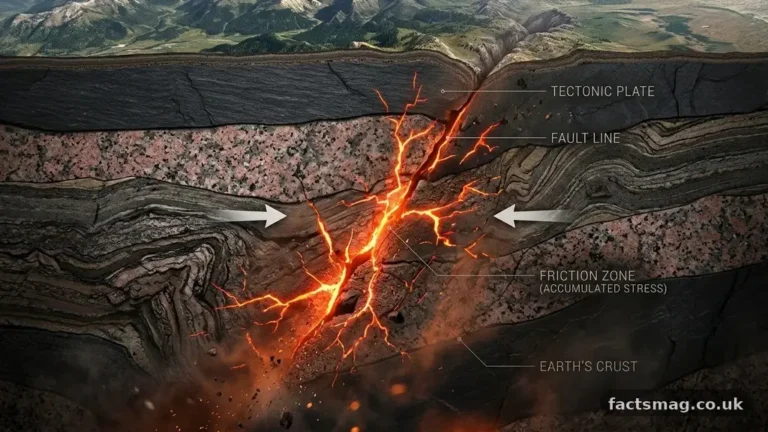
Volcanoes form when molten or partly molten rock from below Earth’s crust finds a route upward. That rock is called magma while it remains underground and lava after it reaches the surface. A volcano may develop around a central opening, along a crack, or through a broad region where repeated eruptions build layers of rock.
The immediate cause of an eruption is usually a combination of rising magma and expanding gas. Magma is less dense than much of the solid rock around it, so buoyancy pushes it upward through fractures and weak zones. As it rises, the pressure around it falls, allowing water vapour, carbon dioxide, and other dissolved gases to expand into bubbles.
Those bubbles can drive a volcanic eruption much like gas propels liquid from a shaken bottle, although the geological process is far more complex. If the magma is fluid, gas may escape steadily and produce flowing lava. If the magma is thick and sticky, bubbles become trapped, pressure builds, and the eventual release can be explosive.
A volcano isn’t simply a mountain with a hole in it. Its underground plumbing can include a magma chamber, branching dykes, cracks, conduits, and several volcanic vents. Some vents are central, while others open on the flanks or along long fissures.
The location of magma generation is controlled mainly by plate tectonics, the movement of rigid plates over Earth’s warmer interior. Most volcanoes occur at divergent plate boundaries, convergent plate boundaries, or hotspots, although no single location guarantees an eruption at a particular time.
Earth’s Heat and the Making of Magma
Earth remains volcanically active because heat left from its formation is still stored inside the planet, while radioactive elements continue to produce heat through decay. The mantle is mostly solid, not a global ocean of liquid rock, but intense heat and pressure allow it to flow slowly over geological time.
Magma forms when mantle or crustal rock partially melts. Partial melting matters because different minerals melt at different temperatures, producing magma with a composition that may differ from its source. The resulting liquid can contain crystals, dissolved gases, and fragments of surrounding rock.
Three ways rock begins to melt
- Decompression melting: Hot mantle rises and experiences less pressure, allowing it to melt without a major increase in temperature.
- Flux melting: Water and other substances released from descending oceanic crust lower the melting point of mantle rock above a subduction zone.
- Heat transfer: Very hot magma intrudes into cooler crust and supplies enough heat to melt nearby rock.
Decompression melting is common beneath divergent plate boundaries, where plates move apart and mantle rises into the opening. It also occurs beneath many hotspot volcanoes, where unusually hot mantle rises beneath a plate.
Flux melting dominates many subduction zones. When one plate sinks beneath another, water stored in minerals and sediments is carried downward, then released into the overlying mantle. That added water helps generate magma, which can rise into the crust and feed volcanoes on the overriding plate.
Heat transfer can make volcanic systems chemically complicated. Magma may stall in the crust, crystallise partly, mix with a fresh batch of hotter magma, or melt sections of the surrounding continental rock. These processes can change its temperature, gas content, viscosity, and eruption behaviour.
Composition is especially important. Basaltic magma contains relatively low amounts of silica and tends to flow easily, while andesitic and rhyolitic magmas contain more silica and are generally thicker. The difference helps explain why some eruptions produce long lava flows and others generate towering ash columns.
Where Volcanoes Develop
Plate boundaries provide the clearest map of global volcanism. The movement of plates creates the cracks, melting conditions, and pressure changes that allow magma to rise. Yet volcanoes at different tectonic settings can look and behave very differently.
Divergent boundaries and rift zones
At a divergent plate boundary, two plates move apart. Mantle material rises beneath the gap, pressure drops, and decompression melting creates basaltic magma. Much of this activity occurs underwater along mid-ocean ridges, where new oceanic crust forms continuously.
On land, the same process can create rift zones such as the East African Rift. Eruptions in these settings may emerge from fissures rather than a single cone. Over long periods, repeated cracking and lava production can widen a continent or help produce a new ocean basin.
Subduction and convergent boundaries
At convergent plate boundaries, plates move toward each other. Usually, dense oceanic crust sinks beneath another plate in a subduction zone, and the resulting water-assisted melting produces chains of volcanoes known as volcanic arcs.
The Andes are a major example of a continental volcanic arc, while the Aleutian Islands form an island arc above subducting oceanic crust. These volcanoes often produce magma with higher silica content, which can be viscous and capable of holding gas under pressure.
Subduction-related eruptions can therefore be explosive, but the danger isn’t determined by location alone. The chemistry of the magma, the amount of water and gas, the shape of the vent, and the condition of the surrounding rock all influence what happens at the surface.
Hotspots away from plate boundaries
Some volcanoes form far from active plate edges above hotspots. A mantle plume is one proposed explanation: a column of unusually hot material rises from deep within the mantle and produces melting beneath a moving plate.
Hawai‘i illustrates how a chain of hotspot volcanoes can develop. As the Pacific Plate moves over a relatively fixed source of magma, older volcanoes become inactive while a younger one forms above the hotspot. Not every hotspot is explained by a deep mantle plume, so scientists examine each volcanic region using geological, seismic, and chemical evidence.
| Volcanic setting | Main melting process | Typical volcanic feature |
|---|---|---|
| Divergent boundary | Decompression melting | Mid-ocean ridge or fissure system |
| Subduction zone | Water-assisted flux melting | Volcanic arc and stratovolcanoes |
| Continental rift | Decompression and crustal melting | Rift vents, lava fields, and fault-related cones |
| Hotspot | Heat from rising mantle material | Shield volcano chain or broad lava plain |
What Happens Inside a Volcano Before Eruption
An eruption usually develops through a sequence of underground changes rather than appearing without warning. New magma may enter a storage region, increase the pressure in a magma chamber, and force older magma upward. The crust can bend, crack, or shift as the system responds.
As magma rises, it may collect in pockets at different depths. These storage areas aren’t always one large, permanent chamber; they can be interconnected zones containing crystals and partially molten rock. A fresh injection of magma can disturb the system and trigger movement even if the volcano has been quiet for centuries.
Gas is central to the process. At great depth, pressure keeps water and carbon dioxide dissolved in magma. During ascent, the pressure drops, bubbles grow, and the expanding gas can accelerate the magma toward the surface.
The rock surrounding a volcanic conduit can temporarily hold back the pressure. Eventually, cracks may join together and create a pathway to a vent. If the conduit remains open, gas and magma may escape gradually; if it seals with solidified lava, pressure buildup can continue underground.
Scientists watch for several physical signals before some eruptions. Earthquakes may occur as magma fractures rock, the ground may swell, volcanic gases may change in amount or composition, and heat output may rise. These clues improve forecasts, but they don’t make the exact timing and size of an eruption perfectly predictable.
Not every intrusion reaches the surface. Magma can cool underground and form solid igneous rock, creating features such as dykes, sills, and large intrusive bodies. In that case, the internal process is real, but no visible volcanic eruption follows.
Why Some Eruptions Are Gentle and Others Explosive
The style of an eruption depends heavily on magma viscosity, gas content, eruption rate, and the shape of the volcanic plumbing. Low-viscosity basalt allows bubbles to rise and escape more easily, often producing fountains and lava flows. High-viscosity magma can trap bubbles until pressure rises sharply.
Shield volcanoes are commonly built by fluid basaltic lava. Their slopes are broad and gently inclined because lava can travel far before cooling. Kīlauea and Mauna Loa in Hawai‘i are well-known examples, although even shield volcanoes can produce hazardous lava fountains, gas emissions, and fast-moving flows in particular conditions.
Stratovolcanoes, also called composite volcanoes, usually have steeper sides made from alternating lava, ash, and fragmented material. Their magma often has a higher silica content, and their eruptions can generate ash columns, pyroclastic flows, lava domes, and lahars.
Major eruption products
- Lava flows: Streams or sheets of molten rock that spread across the ground and harden into new crust.
- Ash: Fine particles of pulverised volcanic rock and glass that can travel far in the atmosphere.
- Tephra: A broad term for erupted fragments, from tiny ash grains to large bombs and blocks.
- Pyroclastic flows: Fast, hot mixtures of gas, ash, and rock that move down slopes with little warning.
- Lahars: Mudflows made from water mixed with ash, loose volcanic deposits, and debris.
Water can make an eruption especially violent. Magma entering a lake, glacier, ocean, or wet groundwater system may turn water into expanding steam. The resulting explosion can shatter magma and surrounding rock, even when the magma itself isn’t exceptionally viscous.
A volcano’s eruptive style can also change during one event. An eruption may begin with lava fountains, shift to an ash-rich phase as the conduit becomes blocked, and later produce a lava dome. That variability is why monitoring continues throughout an eruption rather than stopping after the first release.
How Volcanic Landforms Grow and Change
A volcano is built by accumulation. Each lava flow, ash layer, cinder deposit, or dome adds material, while erosion, landslides, and collapses remove it. Over thousands or millions of years, these competing processes can turn a small vent into a major mountain or leave only a broad volcanic plateau.
Cinder cones are among the simplest volcanic landforms. They form when fragments of lava are thrown from a vent and fall around it, often creating a steep-sided cone with a bowl-shaped crater. Many are relatively small and may form during a single eruptive episode.
Shield volcanoes grow more gradually through repeated fluid lava flows. Because basalt spreads widely, the final landform can cover a large area while rising gently from the surrounding landscape. Their size can be enormous even when their slopes look modest.
Calderas form when a large magma reservoir is partly emptied and the overlying ground collapses. The resulting depression may later contain lakes, new cones, lava domes, or several smaller vents. A caldera isn’t simply a giant crater carved by an explosion; collapse is a defining part of its formation.
Volcanoes can also build land beneath the sea. Repeated submarine eruptions may eventually raise a seamount above sea level, creating an island. Waves and weather then reshape the new land, while coral growth, sediment, and later eruptions add further layers to its history.
Volcanic landscapes often support fertile agriculture because ash and lava weather into mineral-rich soils. The benefit takes time, and it exists alongside serious risks such as toxic gases, ashfall, unstable slopes, and renewed eruptions. Fertility can encourage communities to live close to volcanoes, making hazard planning essential.
How Scientists Monitor Erupting Volcanoes
Volcano observatories combine several kinds of evidence because no single measurement can reveal the entire state of a volcanic system. Seismometers detect earthquakes and tremor, while GPS instruments and satellite radar measure subtle changes in ground shape. A volcano that swells by only a small amount may be showing that magma is moving below.
Gas monitoring provides another important window. Instruments can measure sulphur dioxide, carbon dioxide, and other gases from vents or diffuse emissions in the ground. A change in the ratio or quantity of gases may indicate that magma is rising, although weather and groundwater can complicate the signal.
Thermal cameras and satellites identify changes in heat at crater lakes, lava domes, fumaroles, and active flows. Scientists also inspect ash samples, lava chemistry, and the texture of erupted crystals. These materials can show whether an eruption involves fresh magma, older magma, or interaction between different batches underground.
Public warnings depend on interpreting all these observations together. The United States Geological Survey’s Volcano Hazards Program explains how monitoring and hazard assessments support communities near active volcanoes. Forecasts are expressed as probabilities or alert levels because volcanic systems can accelerate, pause, or change direction.
Preparation reduces risk even when prediction has limits. People living near volcanoes may need evacuation routes, ash protection for buildings and machinery, clean-water plans, and instructions for avoiding valleys that could carry lahars. A volcano’s quiet appearance is not proof that its hazards have disappeared.
Why Volcanoes Matter to Earth and People
Volcanoes are destructive in the short term, but they also perform major geological work. Eruptions create new oceanic crust, raise islands, recycle elements from the interior, and release gases that have influenced Earth’s atmosphere over immense spans of time.
Volcanic gases helped supply parts of the early atmosphere, while later eruptions could cool the climate by sending sulphur-rich particles high into the atmosphere. The effect depends on eruption size, gas chemistry, latitude, and how long particles remain suspended.
Volcanic activity also connects deep Earth processes with everyday landscapes. Basalt can form dark beaches, lava tubes can become caves, and ash deposits can preserve evidence of past environments. Geothermal heat associated with magma supplies energy in places such as Iceland and parts of New Zealand, Italy, and the western United States.
Communities benefit from fertile volcanic soils, mineral resources, tourism, and geothermal power, but these advantages don’t cancel the hazards. A population may live near a volcano for generations without an eruption, then face ashfall, lava, or dangerous mudflows after the system reawakens.
The most useful attitude is neither fear nor complacency. Knowing the local hazard map, signing up for official alerts, keeping masks and water supplies available, and understanding evacuation routes can turn scientific information into practical safety.
Frequently Asked Questions
Are all volcanoes located along plate boundaries?
No. Many volcanoes occur along divergent boundaries and subduction zones, but hotspot volcanoes can form within a tectonic plate. Hawai‘i is a prominent example of intraplate volcanism, although the exact origin of every hotspot remains an active area of research.
Is magma always stored in a large underground chamber?
No. A volcanic system may contain several connected pockets, crystal-rich mush zones, cracks, and temporary storage regions rather than one neat chamber. Some magma travels rapidly through fractures, while other magma cools underground without erupting.
Why does lava sometimes flow and sometimes explode?
Fluid magma lets gas bubbles escape, favouring lava flows and fountains. Thick magma traps gas, allowing pressure to rise until the material fragments in an explosive release. Water interacting with magma can add another source of rapid expansion.
Can scientists predict exactly when a volcano will erupt?
Scientists can often identify increased unrest and estimate changing levels of concern, but exact timing is difficult. Earthquakes, ground deformation, gas emissions, and heat data may indicate that magma is moving without revealing precisely when a vent will open or how large the eruption will become.
Do dormant volcanoes stay dangerous?
Yes. “Dormant” usually means a volcano isn’t erupting now but may erupt again, while “extinct” suggests that future activity is highly unlikely. Because those classifications involve uncertainty, communities near apparently quiet volcanoes still rely on monitoring and emergency planning.
Conclusion
How Do Volcanoes Form and Why Do They Erupt becomes easier to answer once the links between heat, magma, gases, and plate tectonics are clear. Magma forms through decompression, water-assisted melting, or added heat, then rises through weaknesses in the crust; pressure from expanding gases determines whether the result is a quiet lava flow or an explosive eruption.
Volcanoes are both hazards and creators of landscapes, soils, islands, and new crust. To learn about a particular volcano, check its observatory, hazard map, alert system, and evacuation guidance rather than relying on its appearance. The planet’s fiery activity is powerful, but careful science and preparation make it far less mysterious.