How Do Underwater Cables Connect the World to the Internet?
How Do Underwater Cables Connect the World to the Internet The short answer is that submarine communications cables carry digital data as pulses of light through optical fiber laid across the seabed. They link continents, data centres, cloud platforms, businesses, and households, forming the physical Internet backbone beneath the oceans.
These cables are less mysterious than they sound, but their engineering is remarkable. Their routes, repeaters, landing stations, repair systems, and shared capacity determine how quickly a message travels from one side of the planet to another—and why a fault in one narrow stretch of ocean can affect services thousands of kilometres away.
The Short Answer: Light Travels Through Ocean-Floor Fiber
Underwater cables connect the world by converting digital information into flashes or pulses of light. A message, video stream, website request, or financial transaction is divided into data packets, encoded as optical signals, and sent through extremely thin strands of glass called optical fiber.
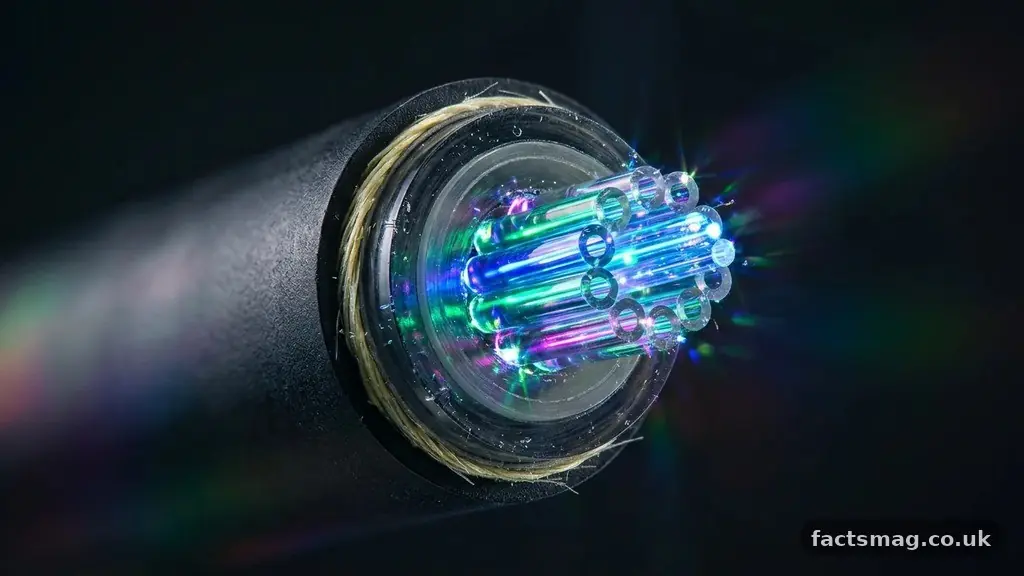
A submarine cable may contain several fiber pairs. Each pair has one fiber carrying signals in one direction and another carrying signals in the opposite direction, although the exact design varies by system. The cable itself is much thicker than the glass fibers because it also needs electrical conductors, insulation, protective layers, and, near shore, armour that helps guard against anchors and fishing equipment.
Signals move through the cable at a large fraction of the speed of light. They don’t travel forever, though. As light passes through many thousands of kilometres of fiber, it gradually loses strength, so powered devices called repeaters are installed along the route to amplify or regenerate the signal.
At each end, a cable landing station connects the submarine system to terrestrial networks. From there, data can travel through national fiber routes to an internet service provider, a cloud data centre, a mobile network, or a company’s private network.
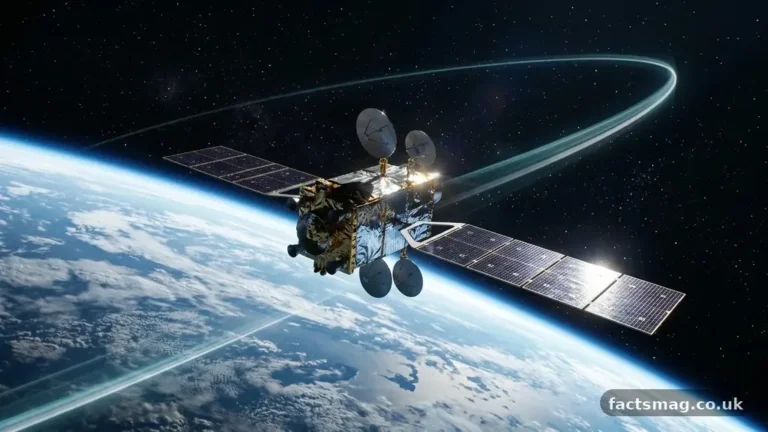
This arrangement explains why underwater infrastructure matters so much. Satellites are useful for remote areas, ships, aircraft, emergency links, and backup connections, but submarine cables carry the great majority of intercontinental Internet traffic because they offer high capacity, low latency, and efficient operation over long distances.
What a Submarine Cable Actually Contains
A submarine communications cable is a layered engineering system rather than a single glass tube. At its centre are optical fibers, usually protected inside a core that keeps them stable as the cable is manufactured, loaded onto a ship, and placed on the seafloor.
Surrounding that core may be steel wires, copper conductors, waterproof materials, polyethylene insulation, and one or more armour layers. The copper or other conductive parts can supply electrical power to repeaters, which need energy even though the information itself travels as light.
Optical fiber carries the information
Optical fiber consists primarily of a glass core surrounded by cladding with different optical properties. Light stays within the core through internal reflection, allowing an enormous stream of information to move along a hair-thin pathway with relatively low signal loss.
Modern systems use wavelength-division multiplexing, which sends multiple colours, or wavelengths, of light through the same fiber. Each wavelength can carry a separate high-speed channel, so one fiber pair can transport far more data than a simple one-signal-at-a-time arrangement would allow.
Protection changes with depth
In the deep ocean, where human activity is limited, cables can be comparatively slim and may simply rest on the seabed. Near busy coasts, the design becomes tougher because anchors, trawling gear, construction projects, and seabed movement create greater risks.
Armoured sections are often used in shallow water. Cable operators also bury cables beneath the seabed where conditions make burial practical, creating an additional barrier between the cable and equipment that could snag or crush it.
- Optical fibers: carry data as light pulses.
- Conductive elements: provide power to submerged repeaters and related equipment.
- Insulation and waterproofing: keep seawater away from sensitive components.
- Steel armour: adds mechanical protection near exposed or high-risk areas.
- Outer sheathing: gives the cable a durable surface for handling and deployment.
The result is a cable designed to survive pressure, temperature changes, movement during installation, and decades of service. It is carefully engineered, but it isn’t indestructible.
How Data Travels From Your Device Across an Ocean
Suppose someone in London opens a website hosted in a data centre in Virginia. Their device first sends a request through Wi-Fi or a local wired connection, then through the access network operated by an internet service provider.
The request moves through routers that examine the destination and select a path across interconnected networks. If the destination is overseas, the route may lead to a terrestrial network connected to a cable landing station on the European coast.
At the landing station, electrical network signals are converted into optical signals suitable for the submarine system. The data then travels through the transatlantic cable, passes through repeaters along the seabed, and reaches a landing point in North America.
On the far side, another landing station converts the signal back into a form that terrestrial fiber networks can carry. Routers then direct the request to the correct data centre, where the website responds and sends information back along the network.
The return trip may use the same cable or a different route. Network operators balance traffic across multiple systems, so the path selected at one moment may not be the path used a few seconds later.
This process happens extremely quickly, but physical distance still matters. A transatlantic trip cannot have zero latency because the signal must cross thousands of kilometres, pass through network equipment, and often travel through additional terrestrial links before reaching the final server.
Content delivery networks reduce that delay by placing copies of popular content in data centres closer to users. A streaming service may therefore serve a video from a nearby city, while a banking transaction or business application may still need to reach a distant central system.
The Cable Network Is the Internet’s Intercontinental Backbone
The Internet isn’t one global machine owned by one organisation. It is a collection of independently operated networks that agree to exchange traffic, connect at shared facilities, and move packets through many possible routes.
Submarine cables form the intercontinental layer of that arrangement. A cable might connect two countries directly, link several landing stations, or become part of a larger route joining regions across an ocean. Multiple systems often operate between major economic centres, creating competition and redundancy.
The phrase Internet backbone describes the high-capacity networks that carry traffic between major cities, providers, data centres, and national networks. Underwater cables are a crucial part of that backbone, but they work alongside terrestrial fiber, routers, exchange points, data centres, and access networks.
Different routes serve different regions
A transatlantic cable connects North America with Europe, while a transpacific cable links North America with East Asia or other Pacific destinations. Systems around Africa, South America, the Middle East, Southeast Asia, and the Pacific islands address different geographic and commercial needs.
Route planning involves far more than drawing the shortest line on a map. Engineers assess seabed geology, water depth, protected marine areas, fishing activity, shipping lanes, political boundaries, existing infrastructure, and the locations of suitable landing stations.
Operators may deliberately choose a slightly longer cable route to avoid a geological hazard or a crowded coastal zone. A route that is easy to repair and has access to several network hubs can be more valuable than one that saves a modest amount of distance.
| Network element | Primary role | Typical concern |
|---|---|---|
| Submarine cable | Moves high-capacity traffic between regions | Seabed damage, faults, and route diversity |
| Cable landing station | Connects the ocean system to land-based networks | Power, security, access, and coastal hazards |
| Repeater | Restores optical signal strength along the cable | Long-term reliability in deep water |
| Terrestrial fiber | Carries traffic inland to cities and data centres | Congestion, construction damage, and local outages |
| Internet exchange or router | Directs traffic between networks | Capacity, configuration, and equipment failure |
Because no single cable carries every global connection, the network can often reroute traffic after a failure. That resilience depends on how many independent systems exist and whether they enter a region through separate coastal corridors.
Why Cables Usually Beat Satellites for Global Traffic
Satellite connections can reach places that are difficult to serve with terrestrial infrastructure. A satellite link can support a remote community, a vessel at sea, an aircraft, or emergency communications without requiring a cable to pass directly nearby.
For intercontinental bulk traffic, however, submarine cables usually provide greater capacity at lower cost per transmitted bit. Their signal path is also shorter than a route that sends information up to orbit and back, which generally helps reduce latency.
Capacity is a central reason. Cloud computing, video calls, software updates, online games, financial systems, machine learning services, and social platforms all move huge quantities of information, and fiber-optic systems can add many optical channels to the same physical cable.
Satellite technology is changing quickly, especially with large low-Earth-orbit constellations. Those systems can reduce latency compared with older geostationary satellites, but they still rely on ground stations, spectrum coordination, space hardware, and complicated network management.
The two technologies are better understood as partners than rivals. A country or company may use submarine cables for its main international capacity and satellites for backup, remote coverage, rapid deployment, or links to locations where cables are not commercially practical.
Connectivity also depends on the land after a cable reaches shore. A high-capacity cable landing in a country with limited inland fiber may not deliver the same experience as one connected directly to several dense data-centre and exchange markets.
That distinction is important for consumers. A fast undersea route doesn’t guarantee fast service if the local wireless tower is congested, the household connection is weak, the destination server is overloaded, or the provider has insufficient capacity between the landing station and the user.
How Cables Are Installed and Repaired
Installation begins with route surveys. Specialist vessels use sonar and other instruments to examine the seabed, identify slopes and obstacles, and produce a route plan that balances safety, cost, environmental requirements, and network usefulness.
The cable is manufactured in long sections, tested, and loaded into a purpose-built vessel. During deployment, the ship moves along the approved path while carefully paying out cable at a controlled rate so it settles onto the seabed rather than being pulled too tightly.
Near shore, a plough or remotely operated equipment may bury the cable beneath the seabed. In deeper water, burial may not be necessary because fishing and anchoring activity are less common, although the cable still has to be positioned safely around rugged terrain and other infrastructure.
What happens after a fault
A cable fault can be detected through changes in optical performance, electrical characteristics, or network monitoring data. Operators compare readings from both ends to estimate where the problem occurred, then coordinate access and dispatch a cable repair ship.
The ship locates the cable using grapnels or remotely operated equipment. Crew members bring the damaged section aboard, remove the failed portion, splice in a tested replacement, and lower the repaired cable back to the seabed.
In shallow water, repair work may also involve reburial. Weather, permits, sea conditions, fishing activity, and the availability of a specialised vessel can all affect how long restoration takes.
Operators prepare for these incidents by purchasing capacity on multiple systems and designing routes that avoid a single shared point of failure. That is why a cable outage may slow a connection without completely disconnecting a country from the Internet.
Repair schedules aren’t always predictable. A remote deep-ocean fault can require a long voyage, while a problem near a busy port may involve additional coordination with maritime authorities and other infrastructure owners.
Who Owns the Cables and Pays for Them?
Submarine cables have historically been built by telecommunications carriers, but the ownership model has broadened. Today, consortia may include several national or international operators, while large cloud and technology companies may invest directly in systems that support their data centres and services.
Shared ownership spreads construction costs and gives participants access to capacity. A company might receive dedicated fiber pairs, a defined amount of spectrum capacity, or rights governed by the commercial agreement behind the system.
Other networks lease capacity rather than owning physical strands. Internet service providers, carriers, content platforms, universities, and large enterprises can purchase long-term capacity or use managed connectivity services without operating an entire cable.
The economics are shaped by distance, landing rights, manufacturing, ship time, route surveys, permits, equipment, insurance, and ongoing maintenance. Publicly announced project costs vary widely, and the full commercial terms of many systems are not disclosed.
Investment decisions also reflect expected traffic growth. A route connecting major data-centre markets may attract several participants, while a cable serving a small island community may need public funding, development support, or a special partnership to become viable.
Ownership can affect resilience and policy. Multiple operators may create competitive choices, but concentrated ownership can raise questions about access, security, maintenance priorities, and how a region would cope if one company’s systems failed.
For readers wanting a neutral overview of international telecommunications standards and infrastructure policy, the International Telecommunication Union’s ITU-T resources provide a useful institutional reference.
What Can Damage an Underwater Cable?
Human activity causes many faults, particularly in shallow waters. Ship anchors and fishing gear can drag across the seabed, catch a cable, and pull it from its position or break its protective layers.
Natural hazards matter too. Earthquakes can trigger underwater landslides that bury or sever cables across a wide area, while strong currents, volcanic activity, and shifting seabed sediments can place stress on a route.
Cables are not normally damaged by fish biting them, despite a persistent popular story. Early cable designs may have faced unusual interactions with marine life, but modern systems use layers of protection and engineering practices designed for the actual risks observed along their routes.
Coastal infrastructure presents a different challenge. A cable landing station may depend on local electricity, road access, terrestrial fiber, and secure buildings, so an outage can occur even when the ocean section remains intact.
Security and resilience
Because cables carry sensitive and economically important traffic, operators and governments pay close attention to physical security. Landing stations are controlled facilities, cable routes are surveyed, and network traffic can be shifted when a system appears compromised or unavailable.
No single measure eliminates risk. Resilience comes from layers: multiple cables, geographically separate landing points, spare capacity, diverse terrestrial routes, tested emergency procedures, and agreements that allow repair ships to respond quickly.
Network maps can also be simplified in public sources. Exact details may be limited for security, commercial, or operational reasons, even though the broad locations of many landing stations and cable systems are publicly known.
Why Latency, Bandwidth, and Route Diversity Matter
Bandwidth describes how much data a connection can carry over a period of time. A cable with high bandwidth can support more simultaneous video streams, cloud workloads, transactions, and downloads, but users only receive the capacity available through the entire chain from their device to the destination.
Latency describes delay. It depends on distance, the speed of signal propagation, routers, processing equipment, congestion, and the number of network hops involved in a connection.
A cable route between two cities may be physically shorter than another option, but the shortest route isn’t always the fastest in practice. Traffic can be redirected around a fault, pass through congested exchanges, or travel inland over a long terrestrial connection after reaching shore.
Route diversity helps prevent one incident from cutting off an entire region. If several cables land at the same coastal site, however, a shared power failure, construction accident, storm surge, or damaged terrestrial corridor could affect all of them at once.
Network planners therefore look for genuine diversity, not just several lines on a map. Separate landing stations, distinct coastal approaches, and different inland paths provide stronger protection than multiple cables that follow the same narrow corridor.
These technical choices have visible effects. A trader may care about milliseconds, a video platform may prioritise sustained capacity, and a remote school may care most about affordability and whether a single fault leaves it offline.
How the Future of Submarine Networks Is Taking Shape
Demand for international capacity continues to grow as companies move applications into cloud platforms and consumers use more high-resolution video, connected devices, online services, and real-time communications. New systems are being designed with larger fiber counts, improved optical equipment, and more flexible capacity management.
Some newer cables use spatial division multiplexing, which can increase the number of fiber pairs in a cable. The goal isn’t simply to make one fiber carry more; it can also be more efficient to build a system with additional parallel pathways and distribute power carefully across them.
Cloud companies are likely to remain important investors because their data centres exchange enormous volumes of traffic. Their systems may connect major facilities directly, while internet service providers continue to use a mix of owned infrastructure, leased capacity, and shared consortium routes.
Environmental planning is also receiving more attention. Cable projects must consider marine habitats, protected areas, seabed disturbance, fishing communities, and the effects of installation activity, even though the cable footprint is narrow compared with many other forms of infrastructure.
Future resilience will depend on more than laying extra cable. Operators need accurate monitoring, spare parts, trained crews, repair vessels, reliable landing stations, and cross-border procedures that let repairs happen without unnecessary delay.
That combination of old and new technology is easy to miss. The Internet may feel wireless at the point where a phone connects to a tower or home router, yet much of the long-distance journey still depends on glass fibers resting quietly beneath the sea.
Frequently Asked Questions
Do underwater cables carry all Internet traffic?
No. Traffic also travels through terrestrial fiber, microwave links, satellites, mobile networks, and local access systems. Submarine cables carry a very large share of international data transmission because they combine high capacity, relatively low latency, and efficient long-distance operation.
How deep are submarine Internet cables?
Depth varies with the route. Cables can lie in relatively shallow coastal waters or cross ocean basins several kilometres deep, following seabed conditions selected through detailed surveys. The cable is usually buried where human activity creates a higher risk, while deep-ocean sections often rest directly on the seabed.
Can a submarine cable be tapped or monitored?
Physical access to a cable is difficult, and modern systems use security controls, encryption, monitoring, and network safeguards. Like other communications infrastructure, cables can still raise surveillance and security concerns, which is why governments and operators treat landing stations, routing, and traffic protection as sensitive matters.
What happens if one cable breaks?
Traffic may be rerouted through another submarine cable or terrestrial path. Users might notice higher latency, congestion, or reduced service if spare capacity is limited, but a single fault doesn’t automatically disconnect an entire country. The effect depends on route diversity and how much capacity was available before the incident.
How long do submarine cables last?
They are designed for long service lives, often measured in decades, but their useful commercial life can end before the physical cable fails. Newer systems may offer more capacity or better economics, causing operators to retire, repurpose, or supplement older infrastructure while maintaining the underlying network.
Why the Ocean Floor Matters to Everyday Connectivity
How Do Underwater Cables Connect the World to the Internet They turn distant coastlines into parts of one coordinated network, carrying light through optical fiber and handing data from landing stations to the terrestrial systems people use every day.
The next time a message crosses an ocean in seconds, remember the less visible chain behind it: route surveys, cable ships, repeaters, landing stations, routers, and teams ready to repair faults. Understanding that chain makes the Internet feel less like magic—and shows why protecting diverse submarine cable routes is practical work that benefits everyone.