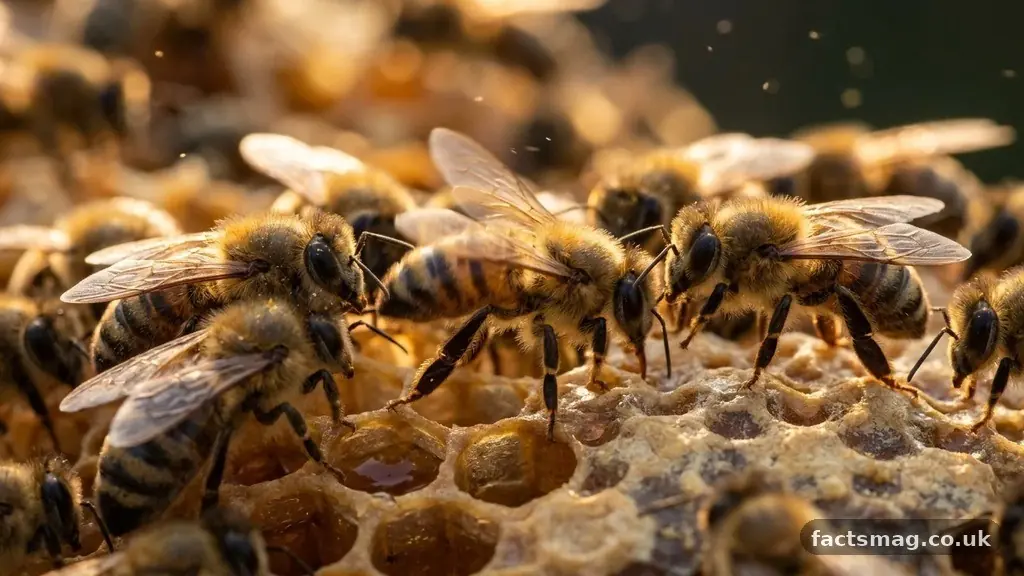
How Do Bees Communicate With Each Other?
To answer “How Do Bees Communicate With Each Other,” look beyond buzzing and watch the whole colony. Honey bees combine dance movements, pheromones, touch, food sharing, vibrations, and visual cues to coordinate jobs that no single bee could manage alone. A forager can help nestmates find a flowering patch, warn them about danger, or guide them toward a new home without speaking in anything like a human language.
These signals matter because a hive is constantly making decisions about food, safety, temperature, reproduction, and relocation. The better we understand those messages, the easier it becomes to appreciate why a bee colony behaves less like a crowd of individuals and more like a responsive living network.
Bees Communicate Through Several Linked Signals
The short answer is that bees communicate through movement, scent, touch, food exchange, and sound. Honey bees do not rely on one universal signal; they select different channels depending on whether they need to advertise food, identify nestmates, raise an alarm, regulate the hive, or coordinate a swarm.
The best-known example is the waggle dance, which a worker performs on the comb after finding a profitable food source. Other bees also read chemical messages from pheromones, make contact with their antennae, exchange liquid food through trophallaxis, and detect vibrations transmitted through the wax comb.
A honey bee’s message is shaped by context. A dancing forager inside a dark hive is mainly communicating through motion and vibration, while a guard bee at the entrance may use scent and physical inspection to recognize a nestmate or challenge an intruder.
The species most often discussed in this context is the western honey bee, Apis mellifera. Its communication system has been studied closely, but scientists still describe some signals as flexible rather than perfectly fixed: the same movement or scent can have different effects depending on colony condition, season, distance, and the behavior of nearby bees.
- Dance signals: communicate the location and value of food or a possible nest site.
- Pheromones: influence attraction, alarm, recognition, reproduction, and colony organization.
- Touch and antennae: allow close-range inspection and information exchange.
- Trophallaxis: spreads food and chemical information among nestmates.
- Vibration signals and wing buzzing: help coordinate activity inside the crowded hive.
Communication is therefore less like sending a single sentence and more like combining several small clues. A worker may follow a scent trail, inspect a dancer, taste a sample of nectar, and respond to the colony’s overall level of activity before deciding what to do next.
What the Waggle Dance Tells Other Bees
The waggle dance is the honey bee’s most remarkable long-distance information system. A returning forager moves in a repeated pattern shaped roughly like a figure eight, with a central “waggle run” in which she vibrates her abdomen and produces rapid side-to-side movements.
The angle of the waggle run communicates direction in relation to the sun. If the bee dances upward on a vertical comb, that generally represents a flight toward the sun; a dance angled to one side represents a corresponding angle away from the sun’s position.
The bee does not need to see the sun inside the dark hive. She uses a sun compass based on the sun’s position and polarized light patterns in the sky, which can remain useful even when clouds obscure the sun itself.
The duration of the waggle run provides information about distance. Longer runs usually indicate a more distant target, although the relationship is not a simple ruler. Wind, terrain, vegetation, flight effort, and the type of landscape can affect how a forager experiences the journey.
A dance also communicates something about the resource’s value. A rich patch of nectar or pollen can attract more recruits than a poor source, while a source that has deteriorated may receive fewer visits and less enthusiastic dancing.
Why direction and distance are not the whole message
Scout bees do not provide a miniature map with exact coordinates. Recruits still leave the hive and search, using their own vision, scent cues, memory, and knowledge of the local landscape to locate the flowers.
Dance followers often touch the dancer with their antennae and may track the vibrations of her body. They can also obtain a taste of the collected nectar, which gives them chemical information about the type and quality of the food.
Researchers at institutions such as the Smithsonian explain the dance as a system that combines directional information with distance and resource clues. The Smithsonian’s overview of honey bee communication offers useful background on how these behaviors fit into colony life.
The dance is not a command that every bee must obey. It is an advertisement competing with other advertisements inside the hive, and the number of followers recruited depends on colony needs, weather, food availability, and the strength of the signal.
Round Dances and Close Food Sources
Before a honey bee performs a clear waggle dance, she may use a round dance for a nearby food source. In this pattern, the bee circles one way and then reverses direction, repeating the movement without the long, straight waggle run that carries precise directional information.
The round dance generally tells nestmates that food is close to the colony. It can encourage searching bees to investigate the area around the hive, where visual landmarks and floral odors may guide them the rest of the way.
Distance boundaries are not rigid. A bee’s choice between a round dance and a waggle dance can vary with the colony, the habitat, and the quality of the resource, so scientists avoid treating the two forms as an exact short-distance versus long-distance code.
Odor is especially important for nearby sources. Pollen and nectar carried back to the hive retain chemical traces from flowers, and nestmates can use those traces when searching outside. A dance may point in the right general direction, while floral scent helps the recruits recognize a promising patch.
There is also an important difference between communicating a location and communicating a resource type. A dance can attract workers to the general area, but the returning bee’s sample and the odor associated with the flowers help other bees decide whether the source offers nectar, pollen, or both.
Foragers can update the colony repeatedly as conditions change. A field that was productive in the morning may become less useful by afternoon, and bees adjust recruitment rather than continuing to send large numbers of workers to an exhausted source.
This flexibility makes the dance system practical in a shifting landscape. Flowers open and close, nectar dries, rain changes scent, and competing colonies may exploit the same patch, so the colony needs information that can be refreshed quickly.
Pheromones Create a Chemical Conversation
Pheromones are chemicals released by bees that influence the behavior of other bees. They are not all used for the same purpose, and a pheromone’s effect depends on where it is released, how much is present, and which bees detect it.
The queen produces a blend commonly called queen pheromone. It helps maintain attraction to the queen and contributes to the social organization of the colony, while also influencing worker behavior and reproductive development.
At the hive entrance, worker bees may release the Nasonov pheromone from glands near the tip of the abdomen. They raise the abdomen and fan their wings, helping spread the scent so nestmates can orient toward the colony or regroup after confusion.
Nasonov scent can be especially useful when bees need to gather at a particular location. Beekeepers may notice workers exposing the scent gland and fanning near an entrance, a swarm cluster, or a new landing point.
An alarm pheromone produces a very different response. When a guard or worker bee detects a threat, chemicals associated with alarm can cause nearby bees to become more alert and defensive, particularly around the entrance or a disturbed section of comb.
One component of alarm signaling is associated with a sting apparatus, which helps direct defensive attention toward a perceived attacker. The odor can remain near the sting site, which is one reason a stung animal or person may attract additional defensive interest.
Scent also helps bees recognize home
Colony odor is a mixture rather than a single label. Nestmates share scents from their bodies, food, wax, nest materials, and the colony environment, allowing guard bees to distinguish familiar bees from outsiders at the entrance.
Recognition is not perfectly individual in the human sense. The guard is responding to a colony odor profile, and the profile can shift with diet, age, season, and the substances bees have contacted.
Pheromones also operate inside the hive, where the air is full of wax, honey, pollen, brood odors, and body contact. Chemical communication is therefore continuous and layered, not limited to dramatic moments such as a swarm or attack.
Touch, Antennae, and Trophallaxis
Many bee messages happen at close range. A bee’s antennae are sensitive organs that detect odors, touch, air movement, and chemical traces, making them essential for inspecting nestmates and gathering information in the darkness of the hive.
When two bees meet, they may touch antennae, mouthparts, or legs. These brief contacts can help identify a nestmate, request food, assess a returning forager, or coordinate movement around crowded comb.
Trophallaxis is the exchange of liquid food from one bee’s mouth to another. A forager may pass nectar to a house bee, which can distribute it to other workers or process it for storage as honey.
This exchange does more than move calories. The taste and smell of nectar provide information about the food source, while repeated food sharing helps distribute chemical signals through the colony.
House bees also feed developing larvae, nurse bees, and sometimes the queen. The colony’s age groups are connected through these exchanges, so food transfer supports both nutrition and social coordination.
Close contact is particularly valuable because many colony decisions cannot be made from a dance alone. A receiving bee can taste the nectar, inspect the forager’s odor, and sense the energy of nearby workers before beginning a task.
Body contact also supports nest hygiene. Bees groom one another, remove particles, and respond to abnormal odors or pathogens on a nestmate’s body, although the exact response depends on the condition and the colony’s behavior.
Vibrations, Wing Buzzing, and Hive Sound
Honey bees communicate through sound and vibration, but “buzzing” is not one simple language. Wing beats create airborne sound, while movements made against the comb can send vibrations through the wax structure.
A worker bee can produce vibration signals by grasping the comb and moving her flight muscles without taking off. These signals travel through the comb and may influence the behavior of nearby bees, including their movement, feeding, or readiness to forage.
Some bees use buzzing during recruitment and disturbance. A returning forager may interact with a nestmate through body contact and sound, while bees involved in swarming produce a shifting mixture of wing noise, movement, and pheromone signals.
Workers can also perform what researchers call piping or related vibrational behaviors during periods of colony change. These sounds may occur around swarming or queen-related events, although their precise meaning depends on the signal and the surrounding behavior.
Wing buzzing has practical effects as well as communicative ones. Bees fan their wings to ventilate the hive, reduce heat, spread scents, and help evaporate water from nectar, so the same physical action may serve several colony needs.
Temperature adds another layer. Groups of workers can generate heat by contracting flight muscles, while other workers fan or move air through the nest. These coordinated actions are regulated through contact, vibration, chemical cues, and the changing conditions inside the hive.
The colony is therefore not silent between dances. Its comb carries mechanical information, and its air carries odor and sound, creating a rich environment where a bee can respond to signals from several directions at once.
How Communication Organizes Colony Life
Bee communication is most impressive when viewed as a system for dividing labor. Young workers typically spend time on tasks inside the hive before becoming experienced foragers, though the timing is flexible and can change when the colony loses workers or faces unusual demands.
Foraging is controlled by need as well as opportunity. A colony with abundant stored food may recruit fewer workers, while a colony facing a shortage can increase interest in successful dances and send more bees toward productive flowers.
Scout bees play an important role during swarming. They search for possible nest sites, inspect cavities, and return to the swarm cluster to advertise promising options through dances and other interactions.
Several scouts may promote different sites at the same time. The swarm does not usually follow the first suggestion automatically; recruitment grows around stronger options until enough bees support a suitable location.
That process is a form of distributed decision-making. No single worker directs every choice, yet the group can settle on a nest site through repeated scouting, recruitment, comparison, and eventual movement.
| Communication signal | Main information | Typical setting |
|---|---|---|
| Waggle dance | Distance, direction, and resource value | Inside the hive on the comb |
| Round dance | Nearby food or a nearby opportunity | On the comb after a short flight |
| Nasonov pheromone | Colony location and regrouping cues | At entrances, clusters, or gathering points |
| Alarm pheromone | Defensive attention and threat response | Near a disturbed bee or hive area |
| Trophallaxis | Food, taste, and chemical information | Close contact among nestmates |
| Vibration signals | Local coordination and arousal | Through the wax comb |
These signals also help colonies respond to failure. If a food patch disappears, recruits may return without finding nectar, and the colony gradually reduces interest in that route. If a hive entrance becomes difficult to locate, scent and fanning can help guide bees back.
Communication is not flawless, and bees can be misled by artificial odors, changing weather, pesticides, or disrupted landscapes. Even so, the system remains remarkably resilient because it combines many partial signals instead of depending on one exact message.
How to Observe Bee Communication Responsibly
You can observe some communication behaviors without opening a hive. Watch a flowering plant from a respectful distance and look for bees arriving, leaving, grooming, exchanging contact, or orienting themselves before flight.
At a hive entrance, bees may fan their wings, pass through a line of guards, or perform short orientation flights. These flights help young bees learn the appearance of the entrance and surrounding landmarks before they begin longer foraging trips.
Do not provoke bees to make their signals easier to see. Smoke, vibration, strong perfume, blocking the entrance, or repeatedly touching the hive can alter normal behavior and trigger alarm pheromone.
Binoculars and a notebook are more useful than getting close. Record the time, weather, flowering plants, entrance activity, and whether bees carry visible pollen, then compare observations across several days.
Beekeepers can learn more by working with an experienced mentor who knows how to open a colony without unnecessary disturbance. Protective equipment matters because defensive behavior can escalate quickly once alarm cues spread.
Gardeners can support the communication system indirectly by planting a range of pesticide-free flowers that bloom across the season. Diverse forage gives bees more opportunities to respond to changing nutritional needs rather than depending on one brief flush of blossoms.
Leave wild nest sites alone when possible. If a swarm settles on a property, contact a local beekeeper or qualified bee-removal professional instead of spraying it, sealing an occupied cavity, or attempting to handle the cluster without training.
Frequently Asked Questions
Can bees talk to one another like humans?
Bees do not use spoken language, but they exchange information through several specialized signals. Their dances, pheromones, touch, food sharing, and vibrations can guide group behavior with impressive precision, even though the messages are not human-style sentences.
Do all bees perform the waggle dance?
No. In a honey bee colony, experienced worker foragers are the bees most associated with the waggle dance. Queens, drones, larvae, and workers performing other jobs do not normally use this dance to advertise a flower patch.
How does a bee know which way to dance?
The dancer uses visual information gathered during flight, including the sun’s position and polarized light patterns. Inside the hive, she translates the outdoor direction into an angle on the vertical comb, allowing followers to infer a flight bearing.
Can bees smell the flowers mentioned in a dance?
Often, yes. Nectar and pollen can carry floral odors back to the colony, and recruits may receive a sample through trophallaxis or contact with the returning forager. That scent can help them identify the target once they are outside.
Why do bees sometimes buzz loudly around the hive?
Buzzing can result from ordinary flight, ventilation, temperature control, recruitment, disturbance, or defensive activity. Sound alone is difficult to interpret, so observers should consider the bees’ posture, movement, location, and any signs of alarm before deciding what it means.
Why Bee Communication Matters
How Do Bees Communicate With Each Other is not answered by the waggle dance alone. Bees coordinate through a living blend of direction, distance, scent, touch, taste, vibration, and sound, with each signal filling a different role inside the colony.
Next time you watch a bee return to flowers or a hive entrance, look for the quiet details: antennae touching, wings fanning, pollen being carried, and nestmates gathering around a returning forager. Those small actions reveal how a colony shares information, adapts to change, and works together without a central controller.